
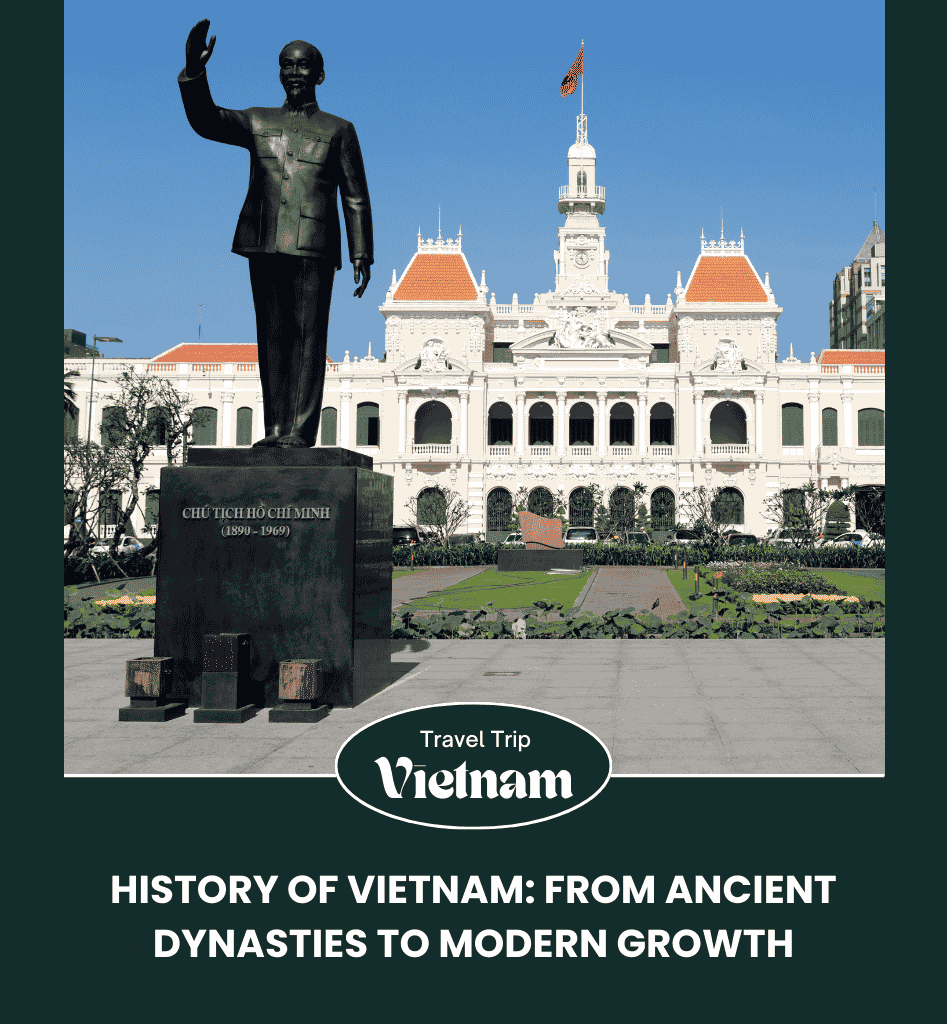
History of Vietnam: From Ancient Dynasties to Modern Growth
Vietnam is a country where traditional customs co-exist with contemporary change. Vietnam Tour Package offers to witness there fascinating and inspiring history, ranging from legendary dynasties and centuries of foreign dominance to one of Asia’s fastest-growing economies today.
Vietnam’s early civilizations, imperial dynasties, colonial conflicts, wars, and amazing path toward economic development are all covered in this blog by Fly For Holidays.
Ancient Vietnam: The Birth of Civilization
Vietnamese civilization has more than 4,000 years of history. In the fertile Red River Delta, where early communities settled, agriculture—particularly rice farming—became the foundation of society.
Vietnam’s first ruling dynasty is thought to have been the fabled Hưng Bàng Dynasty. People created sophisticated farming methods, bronze casting, and a village-based, structured society during this time.
Key Highlights:
- The Đông Sơn culture, renowned for its bronze drums, rose to prominence.
- Wet rice cultivation’s development
- Early Vietnamese identity formation
Read Also: “Vietnam Nightlife Guide: Best Cities for Clubs, Bars & Night Markets”
Chinese Domination (111 BCE – 939 CE)
Vietnam was ruled by the Chinese for almost a millennium, which greatly influenced its philosophy, government, and culture.
During this era:
- Taoism and Confucianism were introduced
- Chinese administrative and writing systems were used.
- Education and infrastructure systems were enhanced.
The Vietnamese people continuously opposed foreign dominance in spite of this influence. The well-known Trung Sisters’ uprising in 40 CE represents early defiance and patriotism.
Vietnam’s independence finally began in 939 CE when Ngô Quyơn, the country’s leader, defeated Chinese forces.
Read Also: “Vietnamese Street Food Guide: Must-Try Dishes for Every Traveler”
The Golden Age of Dynasties (10th – 15th Century)
Following its independence, Vietnam experienced prosperity under strong dynasties like the Lư, Trần, and Lê dynasties.
The Lý Dynasty (1009–1225)
- Established a strong centralized government
- Promoted Buddhism and education
- Developed agriculture and irrigation systems
The Trần Dynasty (1225–1400)
- Successfully repelled Mongol incursions
- Enhanced national and military identity
The Lê Dynasty (1428–1527)
- Introduced legal reforms (Hồng Đức Code)
- Expanded Vietnam southward
- Strengthened education and governance
Many people refer to this period as the “golden age” of Vietnamese Culture and governance.
Expansion and the Nguyễn Dynasty (16th – 19th Century)
Vietnam kept moving southward, and by the 18th century it had reached its current boundaries.
The final dynasty to rule Vietnam was the Nguyễn Dynasty (1802–1945). Although it brought the nation together, it continued to be primarily an agricultural nation with little industrial growth.
Key Features:
- Strong Confucian governance
- Limited foreign trade
- Agriculture dominated the economy
But this was also the time when foreign meddling started, which resulted in French colonization.
Read Also: “Top Tourist Attractions in Vietnam: From Ha Long Bay”
Best Time to Visit South Korea
Each of the four distinct seasons in South Korea offers a different kind of travel experience.
Spring (March – May): Best for cherry blossom festivals and pleasant weather.
Summer (June – August): Warm weather and festivals, but can be humid.
Autumn (September – November): The most popular season for colorful fall foliage.
Winter (December – February): Ideal for skiing, snow festivals, and winter landscapes.
The best months to visit South Korea, according to most tourists, are April and October.
Read Also: “South Korean Culture & Traditions – From Hanbok to Modern Lifestyle”
French Colonial Rule (1858–1945)
Vietnam underwent significant social and economic transformation when it joined French Indochina.
Impact of French Rule:
- Development of railways and infrastructure
- Introduction of Western education
- Exploitation of natural resources
Nationalist movements grew as a result of the high taxes and inequality that the Vietnamese people experienced during modernization.
Read Also: “Discover Vietnam: A Complete Guide to the Land of Blue Dragon”
The Vietnam War and Division (1954–1975)
The Vietnam War is among the most pivotal periods in Vietnamese history.
Following the French defeat in 1954, Vietnam was split up into:
- North Vietnam (communist)
- South Vietnam (anti-communist)
A major war involving world powers, particularly the United States, resulted from the conflict’s escalation.
Key Outcomes:
- Massive destruction and loss of life
- Reunification in 1975
- The Socialist Republic of Vietnam was established in 1976.
Read Also: “How to get Vietnam visa from India in 2026?”
Post-War Challenges and Recovery
After the war, Vietnam faced:
- Economic isolation
- Poverty and infrastructure damage
- Limited global trade
Up until the late 20th century, when reforms altered the country’s course, it struggled.
Read Also: “How to Plan a 10-Day Vietnam Itinerary for First-Time Travelers?”
Đổi Mới Reforms and Economic Growth (1986 – Present)
Vietnam began the Đổi Mỹi economic reforms in 1986, moving from a centrally planned economy to a market economy with a socialist focus.
Results of Reforms:
- Rapid GDP growth (over 6% annually in the 1990s)
- Significant reduction in poverty
- Expansion of global trade
- Rise of manufacturing and exports
Between 1990 and 2000, Vietnam’s GDP increased by almost five times, demonstrating the country’s transition into a dynamic economy. Vietnam’s economy is currently among the fastest-growing in Southeast Asia.
Read Also: “Vietnam Trip Cost from India: Everything You Need to Know”
Modern Vietnam: A Rising Global Power
Vietnam in the modern era combines innovation and tradition. Rapid urbanization and economic growth are exemplified by cities like Hanoi and Ho Chi Minh City.
Key Strengths Today:
- Strong export economy (electronics, textiles, agriculture)
- Growing tourism industry
- Increasing foreign investments
Vietnam has effectively developed into a major global manufacturing hub and a desirable travel and business destination.
Read Also: “Vietnam Trip Cost from India: Everything You Need to Know”
Why Vietnam’s History Matters Today
Understanding Vietnam’s history in the explanation of:
- Its strong national identity
- Cultural resilience
- Rapid economic progress
Vietnam’s journey is one of tenacity and change, from opposing foreign dominance to welcoming globalization.
Read Also: “Essential Documents for a Tourist Visa to Vietnam”
Conclusion
Vietnam’s history is a compelling story of growth, resistance, and survival. Vietnam has constantly reimagined itself, from historical dynasties and cultural accomplishments to colonial conflicts and contemporary economic prosperity.
It is now a shining example of how a country can overcome hardship and emerge as a major force in the world economy.
History of Vietnam: From Ancient Dynasties to Modern Growth Faq's
What is the history behind Vietnam?
Historically, Vietnam goes back further than written records show; it has been through multiple dynasties, being ruled by Chinese forces at various times, attaining independence (from France) as well as experiencing colonial rule from both Portugal & England.
What is the most historical place in Vietnam?
The top destinations for historical tourism are The Old Quarter of Hanoi, Cu-Chi Tunnels, Imperial City of Hue and My Son Sanctuary.
Is Vietnam a good destination for history lovers?
Vietnam has plenty of historical sites including places like war museums, ancient temples, various types of UNESCO recognized heritage sites.
Can you visit battle sites in Vietnam?
If you’re visiting, there are several types of memorials related to the War including the War Remnants Museum and Cu-Chi Tunnels.
Where to visit in Vietnam for war history?
To get an excellent view into what Vietnam was like before and after the Vietnam War, go visit The War Remnants Museum in Ho Chi Minh City, Cu-Chi Tunnels, DMZ (Demilitarized Zone) near Hue and Hoa Lo Prison in Hanoi – these locations provide an emotional view into a turbulent time in Vietnam’s past.
Which UNESCO World Heritage Sites in Vietnam are historical?
There are 9 UNESCO World Heritage sites in Vietnam including the popular Hoi An Ancient Town and My Son Sanctuary.
Is Vietnam a good destination for history lovers?
Yes, Vietnam is a great place for the historical traveler to explore Southeast Asia for Cultural and Heritage Tourism.
How does Vietnam’s history attract international tourists?
Its combination of war history, ancient culture, and colonial heritage offers a unique travel experience.
Why is the Vietnam War so significant?
The Vietnam War attracts visitors interested in history, especially to war sites, museums, and tunnels that showcase real-life experiences.
How has Vietnam’s history influenced tourism?
Vietnam’s history has created iconic attractions like war museums, ancient cities, and heritage sites that draw millions of tourists every year.